In a few days, Latvia will celebrate its 100th birthday. How many couples have said "yes" to each other during these hundred years, how many love stories have been told! Although wedding traditions and customs have changed over the course of a hundred years, just like Latvia itself, there are still couples for whom it is important and meaningful to include Latvian elements in their wedding, not forgetting where they come from and what their roots are.
LĪGAVĀM introduces four such couples, each of whom has something to say about Latvia and themselves in it.
Madara and Edgars – humping, branching and reaching towards the sun
Madara and Edgars have danced Latvian folk dances almost all their lives, therefore Latvian traditions are close to both of them.
It was clear to them that they did not want to get married either in the church or in the registry office, but to find a special and energetically strong place for both of them. That's what they found - Dambju bigoose.
"For Latvians, the oak is a symbol of strength, while the acorns of the oak symbolize luck. This place is also special because my husband had a cross under the Dambja oak tree. But the owners who take care of the oak area said that this was the first time that someone got married under it," says Madara.
Another thing that was important for both of them to include in their wedding is the Latvian characters, which were used both in the wedding decorations and in the festive outfits.
The bride has had a tattoo of the Austra tree on her back for several years, so the wedding dress was sewn in such a way that it was visible.
On the other hand, the same Austra tree was embroidered on Edgar's vest. "Although this mark was embroidered only on women's clothes in the past, I think it is not only a feminine mark, but a strong mark for everyone.
While searching for information about this Latvian sign, I found a very accurate insight: "We must carefully cultivate the oyster tree within ourselves, let it sprout, branch and reach towards the sun," says Madara. Wedding rings also have a Latvian sign engraved, namely Jumis, which symbolizes fertility.
At the wedding feast - irbites, but the first dance - Gatve dance
Madara and Edgars also paid special attention to the wedding treat, because they wanted the food served to reflect Latvia. "In the past, very rich tables were laid at weddings. Our caterers were very involved with ideas and advice about real Latvian dishes - there was a roast, stewed cabbage, partridges, and chicory coffee the next morning. Everything was served in clay pots and on wooden trays," Madara and Edgars say.
On the other hand, the first dance, as the dancers should, right after the wedding ceremony, right there under the oak tree, was the well-known Gatve dance . Madara admits that even when she was little, she knew that she would definitely dance the Gatwe dance at her wedding.
"We wish Latvia a lifetime of sunshine and love, health and happiness for its people. We would like everyone to be proud of their country. Latvia should be glorious in the centenary, with our symbols and smiling people," added Madara and Edgars.
Anna and Jānis – modern wedding with Latvian elements
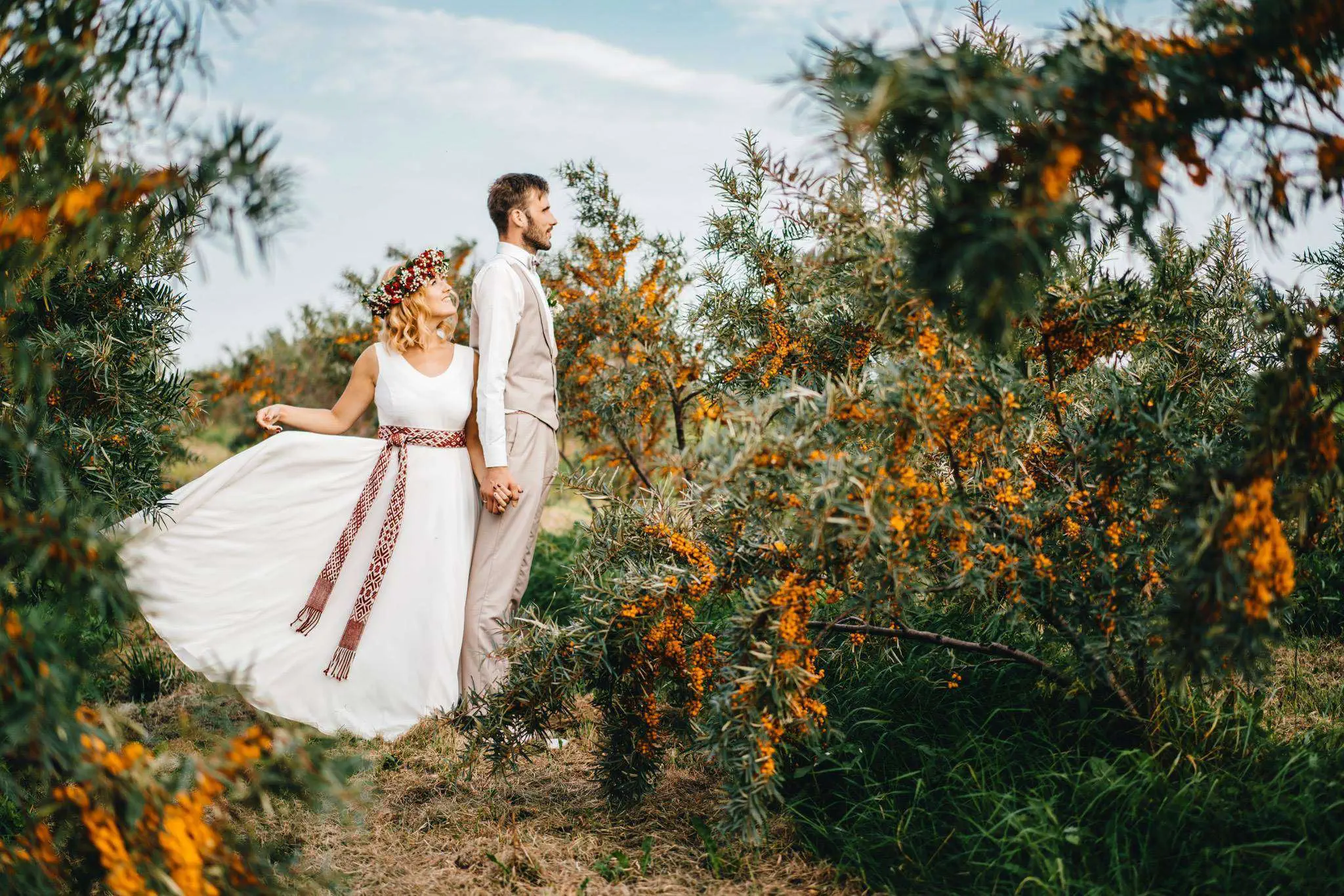
In the wedding of Anna and Jānis, there was neither a ritual of impersonation nor folk costumes, but there was no lack of Latvian elements in their special day, because the wedding seemed unimaginable without any evidence of who they are and where they came from.
There was both the redemption of the bride in the morning, as well as Latvian dancing and dancing under the leadership of Julgī Stalte and her team. Pie tam kāzas notika vasaras saulgriežu laikā, kad, kā uzskata jaunais pāris, ikvienā nedaudz pamostas latviskais gars un “velk” uz pļavām un mežiem.
"We also tried to stick to this feeling - meadow flowers, fairies and celebrations in a charming place in the middle of the forest, away from the noise of people. I also put a wreath of flowers on my head, instead of a veil," says Anna.
But the most special story is about Lielvārde's belt, which complemented Anna's wedding dress. "I knew that on the wedding day I definitely wanted some Latvian element in my outfit, and I am very lucky that my mother started weaving national belts several years ago. So I got the Lielvārde belt, which, in my opinion, is one of the most iconic and beautiful elements of the Latvian national costume.
The fact that my belt is my mother's handiwork makes it an indescribable treasure, which, together with the memories of how my mother tied it around my waist on the morning of the wedding, I will keep for the rest of my life," Anna is sure.
Both still give Latvia people who are proud of their roots. "It will mean something different to everyone and it will not be related to traditions or folklore for everyone, but so that everyone, no matter where they are in the world, is proud to say they are Latvian!".
Zanda and Kristaps – strength is in the roots
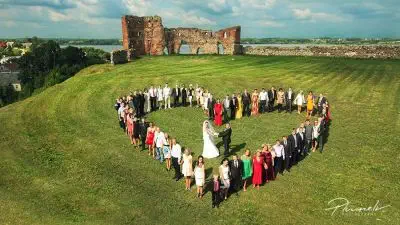
This summer, Zanda and Kristaps experienced a Latvian wedding down to the last detail. Not only were they dressed in full folk costumes and observed ancient Latvian traditions, but the wedding took place in the Ethnographic Open Air Museum of Latvia during the Song and Dance Festival.
"Latvian weddings, in our understanding, are those that are celebrated according to ancient Latvian traditions and in which a certain set of rituals are practiced in order to give the new couple a blessing, knowledge and strength for future family life.
Traditions express the code of our people, which is unique and is the basis of who we are. For us, our wedding meant going back to our roots, because the strength is in the roots. We celebrated our wedding according to Latgali traditions, but we chose folk costumes for the wedding dresses.
We celebrated the wedding during the Song and Dance Festival, which in a sense is also a set of rituals that unites the nation and makes it stronger," Zanda and Kristaps say.
They believe that a wedding with Latvian traditions gives an opportunity to receive the blessing of nature and our ancestors, to feel belonging to our land and also to pass on information about customs to future generations.
"Traditions become such when they are repeated for a long time. If a ritual has stood the test of time, it is very likely that it contains energy or knowledge that was important to previous generations," said Zanda and Kristaps.
"Latvia has a very lively nature, it really recharges. We wish Latvia to preserve the splendor of its nature, but for Latvians to realize their depth and agree on a joint ritual that would help Latvia grow," the still young couple.
Evita and Artur – family strength
Evita and Arturs believe that Latvian weddings are those, the majority of which take place in nature, the rituals are rooted in the wisdom of ancestors, and the process uses things found in nature itself or specially prepared.
"In such weddings, the emphasis is on the pairing of the bride and the groom and the reception of this new couple into the families of the wife and husband's relatives, but not so much on placing the couple in front of the law and / or the church," says Evita and Arturs, who had a Latvian wedding on the coast of Dižjuara (as the Baltic Sea is called on the Kurzeme side).
Their wedding included both songs and merry dancing, games and delicacies from local products.
The young couple at their wedding wanted imitators with experience, that's why their marriage ceremony was led by a couple with long experience of living together and several children, because they also want a stable and big family.
This is also what they wish for Latvia. "We want strong and well-rounded families, where everyone does their own thing, not sitting idly by and waiting for someone to put something in front of them. We want to have people in Latvia who know how not only to consume, but also to create, this will shape the sustainability of Latvia," said Evita and Arturs.
Wedding place - place of power
On the other hand, Evita and Arturs advise other couples to use rituals and traditions that are well understood by themselves, seem meaningful and symbolically important. "We don't think there's any point in going up on a plate, closing a key lock at the bridge, or putting on a veil just because most people do it.
When planning a wedding, we recommend that you listen to yourself and understand what is most important and why we as a couple choose to perform one of the rituals and the marriage in general. It seemed important to us to be in a place that had already become important to us by experiencing several special moments there, as well as to make it a place in the nature of Latvia, where you can return to when you need to restore your inner strength reserves.
It was important for us to follow Latvian traditions, because we believe that our ancestors participated in similar rituals in ancient times, and by performing ancient rituals, we will be able to strengthen both ourselves as a couple and those around us," said Evita and Arturs.

 share
share