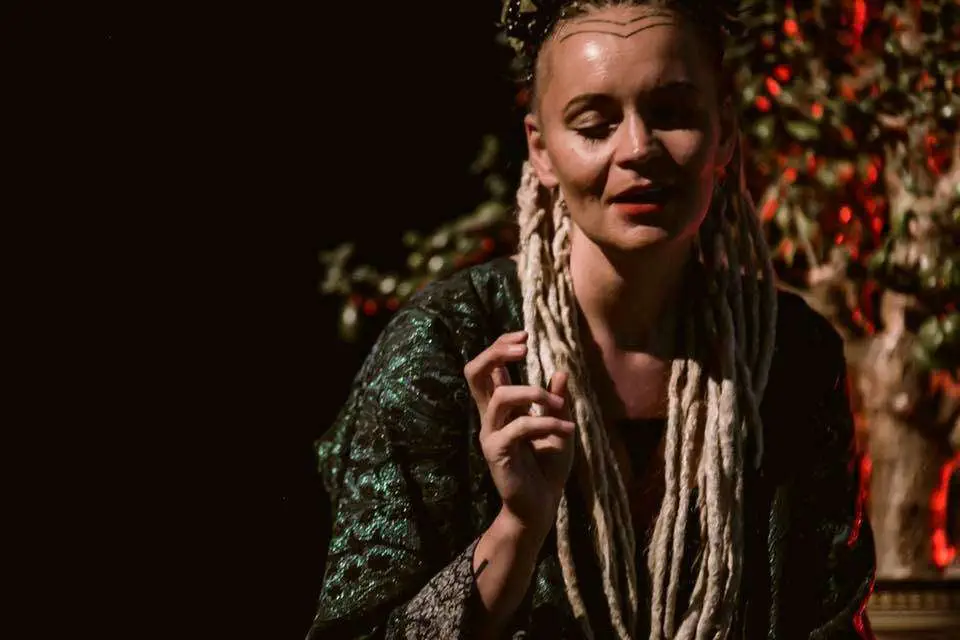
The wedding ceremony is the essence of the whole wedding day - the moment when "I and you" turns into "we are". What does this "we" really bring with it and what is the true meaning of the wedding ceremony? For this, LĪGAVĀM shares the herbal wife and soul support ININ NINI, , who invites couples to be brave in creating their wedding day.
In the beginning, the Divine divided the Soul into two parts. These two parts search for each other through times and lives. And holy, infinitely beautiful is the moment when these parts of the soul meet again and unite into one whole, each with its own special contribution, preserving and respecting its own values and free will, and yet making the decision to create and experience life together in the future.
A true marriage ceremony is a moment when this very moment is celebrated - the meeting and union of souls to create a new world. This is the moment to announce to the room loud and bold - we are here! We have met. It is a moment to thank everyone and everything that this meeting could happen.
Do not confuse gratitude with pleasing
This should be the basis of the marriage ceremony. For nothing else - neither the ego's need to prove himself, nor to please society or family. It is the reuniting of two souls and the invitation of love to all that is to come that the souls will create together. All my work as a marriage celebrant, leading the ceremony, is based on this setting. From it, together with the couple, the course of the marriage ceremony is carried out in a very special and individual way.
From this point of view, the couple must carefully evaluate what their wedding day will be dedicated to. Or really to celebrate your love? Or for the sake of dear peace, will it be a compromise between celebrating yourself, satisfying your parents' tastes, and entertaining your relatives?
It is important to make an honest decision - will we celebrate our love or will we please others. Pleasing should not be confused with gratitude and showing love, honoring ancestors and relatives - it must be given a moment.
Are we going to implement elements, traditions that we believe in, or repeat things that are traditional but not felt and understood in our hearts?
Wedding day as the first exam of future life
I invite you to be brave in creating your wedding day. If there is a feeling that the worlds are too different - your world and that of family, friends, then it is definitely possible to "divide" the event into sections, which can even take place on separate days.
For example, an intimate ceremony in the presence of only the blesser and witnesses (or even without them) and a separate solemn section for relatives and friends.
When it comes to the celebration, the couple has every right to say what kind of music, mood, elements they want and, what is very important, what they really don't want. And ask yours to respect it. The wedding day can be your first confirmation that you will create the world as you see yourself and will not accept things that are unacceptable to you. Maybe even the first exam as a new "unit" - how, with love, sensitivity and listening, you will still be able to firmly stand up for your needs and desires.
Alcohol and partying are incompatible
What quality and vibe will the music play at the celebration? Does it match your feeling or do your guests like you? For the joy of the closest people, you can dedicate one favorite song to each important person, but the rest of the musical mood should be created in the light that you are yourself.
Alcohol is a very acute and debatable matter. It cannot be combined with sacred rituals in any way. For example, the tradition of dancing. If you want to develop it as a true ceremony of fertility, gratitude for the past and intercession for the future, then alcohol is unthinkable in this context.
If it is known that the guests will be drunk, it is better not to do such sacred, beautiful things. Everyone will feel disappointed - both the newlyweds, who will be disturbed by different energies in the room, and the guests who will be intoxicated waiting for a "bigger show", and the invited performers of the rituals, who will not be able to fully complete their sacred work. It can be replaced with heartfelt dances, bouquet throwing and other subtleties. In that case, it is necessary to strictly agree with the parents, ushers and organizers so that the matching or matching ceremonies are not presented as a gift without the knowledge of the new couple.
The other version is, of course, an alcohol-free wedding, but this requires enormous courage and the ability to find ways to entertain those present - unfortunately, this is the modern reality, where a celebration without alcohol is not a celebration. There are also middle ground options - for example, a wedding ceremony in the evening, followed by a party and alcohol is served afterwards. It is necessary to be acutely aware of these things, they should not be swept under the carpet, so as not to experience unpleasant moments and disappointments.
It is extremely important to be honest
For me, as a consecrator of marriages, of course, the most important thing is the marriage ceremony itself, which in my case is not tied to any religion, but includes the deepest teachings of all religions - the approach of mystical schools. This means that the Love or Divine that I am inviting into the space does not have one specific name, on the contrary, I am aware that it has many different names. In one part of the world it is God, Jesus and the Mother of God, in another it is Krishna, in our own land - Dieviņš, Mara and Laima. In the shamanic sense, it is Mother Earth and Father Sky.
However, sometimes I have had conversations where a couple says - we don't want God's name to be invoked, we don't believe in the God of the church. Then there is an important conversation about what the couple believes in, how they feel love, the presence of over-materials. And do you feel it at all? Because the word to denote is not decisive, we can find it together, but whether the couple feels and believes in something bigger is very important. Because otherwise, the marriage ceremony under the guidance of a priest of any school (and also an impersonator) loses its meaning. A marriage ceremony is by definition a divine invitation - we both are united by something superior, greater, we acknowledge it not only among ourselves, but also in front of witnesses. And we undertake to take equal responsibility for this sacred, incalculable, mystical to stand up with our thoughts, words and deeds.
This is the meaning of alignment, hand-binding, and church ceremonies. If it is contrary to the couple's belief, it is also very nice and alternative to agree with a representative of the registry office, who will write you officially and without calling things that you don't feel.
It is extremely important to be honest in this matter, because "you will not wear the word of God (you can replace it with the word Love) in vain" is an actual value in all spiritual paths, no matter where in the sky we are.
The reunion of souls, the entwining and celebration of this miracle is sacred, infinitely beautiful. It deserves a sincere, felt attitude, in which ostentatiousness is put aside for a moment and the most important thing is understood between the couple - why this is being done, what we want to convey to the world with this.
Finding the core of these values, from which the most wonderful celebrations, deeds, colors, costumes, sounds, dance steps can be grown and blossomed. It shouldn't be the other way around, weddings should come from the heart.

 share
share