How to create a comfortable seating plan for guests at a wedding
Foto: PINTEREST
In order not to create a mess when entering the ballroom on the wedding day, with guests walking around and not knowing where to sit, creating a seating plan is mandatory.
It is very important to take into account several nuances that allow you to seat guests as efficiently as possible so that everyone is comfortable and only the most pleasant memories remain after the wedding.
According to what principles guests can be seated:
By age (youngest with the youngest, oldest with the oldest)
By language (so that those sitting at the same table speak the same language)
By kinship (bride's relatives, groom's relatives)
By interests (work colleagues, classmates, childhood friends)
How the shape of the tables affects the placement of guests at the tables:
If there are round tables at the wedding, please note that the maximum number of guests at a table with a diameter of 1.8 meters is 10 people. If caterers say they can seat 11 or 12 people, don't believe them. Guests will elbow each other and feel uncomfortable. A maximum of 8 people can be seated at round tables with a diameter of 1.5 to 1.6 meters.
If you are going to seat the maximum number of guests at the round tables, remember that someone will have to sit with their back to you. Pay attention to this and do not seat parents or other important guests in these back-facing seats.
If you don't want someone to sit with their back to you, then sit at the table 1 to 2 people less than the size of the table allows. Then a space is left at the table where the guests do not sit. But when seating guests around the table, keep in mind that the first and last guests on the list cannot be a couple, so that space does not come between them.
If you want to seat guests at long rectangular tables, take into account that the width of the table should be at least 90 cm. Otherwise, there will be no space on the table to place glasses, decor or food in the middle (if it is planned to stand on the tables).
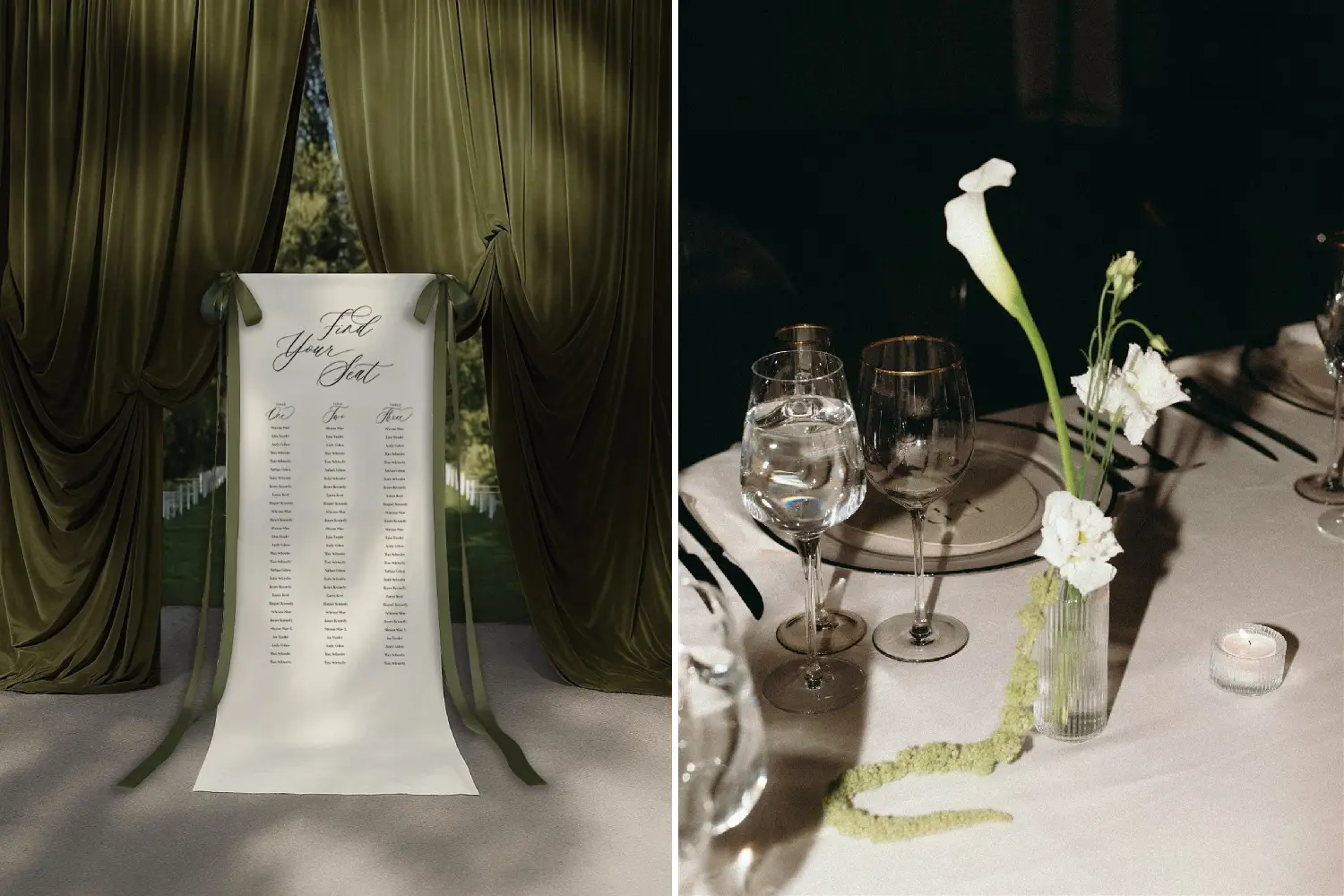
Photo on the left: LINDA UNGURE / Photo on the right: SANTA APŠENIECE
What to consider when planning seating for children:
Remember that a child of any age (except babies who are not yet sitting independently) should have their own seat, because it will be very uncomfortable for the child's parents to hold the child on their lap all evening.
Children up to about 2.5 years old should be written as a plus for mothers in the seating list - they will be offered high chairs, but they will not be counted at the table (they will not have their own plate and utensils).
Children from about 2.5 years old should be written at the table as individual guests in the seating list - they will be provided with chairs (as for all guests) and cutlery.
If there are several school-aged children at the wedding, then a separate children's table can also be created.
If you're not sure how the children would be better off, don't hesitate to ask their parents that question.
Other important nuances related to the drop-off of guests:
Do not seat older guests at the tables closest to the stage or DJ. Sound equipment is usually placed there and the volume may be uncomfortable for the elderly.
Parents are usually seated at the tables closest to the couple.
If several guests have the same first name, then the first letter of the last name (Anna M.) should be written on the table card. If these guests have a significant other with them, then you can not write the first letter of the last name, they will understand who is sitting where by their significant other.
Before allocating seats, calculate how many guests there are in total. After allocating seats, check that the number of seated persons matches the number of guests and that all guests are assigned a seat (a common mistake is that one guest is seated in two places, and another guest is completely forgotten).
When the seating plan is ready, carefully check the spelling of all the words and think about how you want to indicate the name of the guest (for example, it is preferable to write Artis instead of Archa).
Think about how to write parents, grandparents, for example Liene or mother of the bride in the seating plan and on the name cards.
wedding photographer: MICK SCHEL
The seating plan must be prepared in 2 formats:
List of guests by table. You give this list to the print designer, who creates the large seating plan based on this list. It is placed at the entrance to the celebration hall. Also, from this list, the designer writes the names of the guests to make name cards.
Banquet hall scheme with drawn tables, where it is indicated where the tables are located in the room and what number each table has. At each table, it is indicated exactly where each guest is seated. Remember that the organizer or coordinator puts the name cards on the tables on the wedding day, not the bride. They don't know your guests. Therefore, it is important for the person in charge to know which name card to put next to which plate, in order to avoid awkward situations when, for example, parents are seated at the round table with their backs to the couple.
This website uses cookies to improve the user experience and optimize its performance. By continuing to use this website, you agree to the use of cookies on this website.
Read more

 share
share