How to choose a destination for the honeymoon, where to go to really enjoy the time together? One of the most popular Latvian travel destinations recently is Cuba, and the author of the Latvian travel inspiration blog Sapņu Medniece ( www.sapnumedniece.lv ) Alina, who visited Cuba as a couple with her husband Jēkab, who is the author of fantastic photographs, shares her experience of a trip to Cuba. Follow their adventures in other countries also on Instagram ( www.instagram.com/lincalincalinca ) account!
Our trip to Cuba
Cuba is so versatile! It is both an untamed island of freedom, which can be visited in a budget option, hitchhiking, riding local buses and living with local casa particulare ; but also luxury Cuba, where you can enjoy the local flavor in doses - in one of the many hotels in Varadero resort. There are large all-inclusive hotels with sandy beaches, pools and SPA treatments. You can organize a trip to Cuba by just buying a plane ticket and planning everything yourself, or by immediately booking a charter flight ticket and a hotel, for example, at a travel agency.
Although May is considered an off-season in Cuba, due to the approaching rains and heat, we are not sad about it and are safely on our way! The flight is from Frankfurt on a charter flight full of German tourists, and we get to the hotel in an organized way by a tour company bus. The hotel market in Cuba is just starting to open up to big companies, so you have to expect that,
if you plan to spend more time in the hotel than just overnight, you should choose a higher class and one with a higher number of stars, because here their standard is a little lower.
When booking, you should definitely state that this is a honeymoon, and then you can expect nice surprises from the hotel!
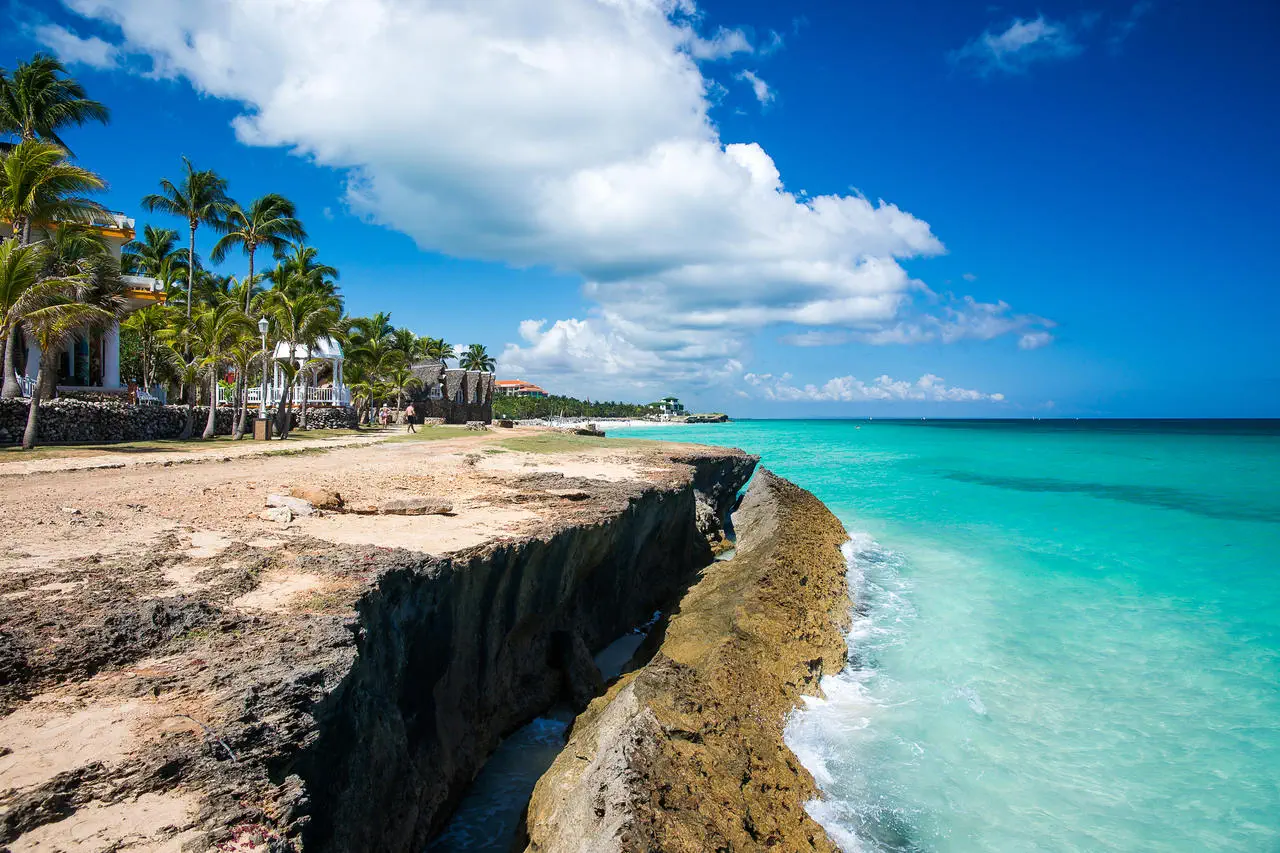
Varadero is fantastic - the turquoise water that we can also see from our room at sunset, a tidy area with palm trees and a sandy beach that we don't want to leave. It just seems that the vast majority of visitors do the same - you can definitely lie in the sand here for a week, enjoying endless rum cocktails and freshly made mango smoothies!
We also want to see something and not just sleep, so we go on a trip with local drivers. Both completely retro cars and also in more modern cars, which the drivers also clean with small rags and brushes at every free moment. It's hard to say what Cuba was like five or ten years ago, but Cuba is definitely not what it used to be. "Socialism or Death" signs and drawings of Cubans punching Uncle Sam are still visible on the sides of highways, but tourism has become a very important source of income for Cuba. The fact that Cuba still has two currencies, moneda nacional or MN and CUC or convertible peso (the ratio of MN to CUC is 25 to 1, 1 CUC is 1 USD) is a sign of socialism.
There are tourists and locals in Cuba. Where there are many tourists, the locals live relatively well - they have the latest smartphone models shining in their hands. Life in the big cities seems to be the same as elsewhere in the Caribbean, but on one day of the trip we ask you to stop at Jovellanos , a town with nothing of tourist interest, except for the Vladimir Ilyich Lenin collective farm a few kilometers away. The eyes of all the passers-by turn to us and the conversations are interrupted. We quickly run around a few blocks and see the Cuban poverty we've heard about before. There is absolutely nothing in the grocery store here. In an electronics store, you will see nothing more than wall clocks. We have not even gone far - we are on the highway on the way to the Bay of Pigs. By the way, the fields here are still cultivated using cattle and tractors are rare.
Commission and dollar tree
Before going to Cuba, you should read the alternative guide to Cuba, Cuba Conga . If you have a Cuban friend, your travel costs can be 30% higher than if you travel alone. For every lunch that your Cuban friend takes you to, he will receive a commission. Of course, it is not deducted from the restaurant's profit! Imagine you are walking down the street and you see a tree with dollars growing on it. Will you pass it? Definitely not! If even a leaf falls from it, you will shake it until nothing more comes off. Welcome to Cuba, you are a dollar tree!
During the trip we laughed that rum is cheap but toilets are expensive. At every cafe, gas station, hotel toilet there is a woman who hands out a sheet of toilet paper and points to a plate with 1 CUC coins. It is said to be this woman's only source of income, she cleans the toilet and the tip stays with her. For comparison, a bottle of 0.3l Santiago de Cuba rum costs 3.80 CUC. Money is requested even if you have your own toilet paper with you and you are a cafe guest who has just paid for an expensive lunch. After two days of complaining about the fact that a visit to the toilet costs almost a euro! We discovered that you can also put coins of a smaller denomination - 10, 25 centavos - in the plate, and thanks are said for them and the gesticulation stops. The only difference is that when you come out of the toilet, the small coins will have already disappeared in the purse, and the plate, as always, will have only 1 CUC coins.
In Havana – from slums to santeria
We go to Havana with a guide and a driver who drives a 1957 Ford, the speedometer does not work, the seats are laminated, and sometimes even the air conditioner is turned on! Tourists abound in Havana, as do pushy vendors selling banana leaf cigars, caricature artists, and women dressed in folk costumes who throw themselves around men's necks and kiss them.
Old Havana is being restored to its full glory – cobbled streets, ancient buildings, the famous Cathedral Square and the Church of Saint Francis.
There are beautiful houses in Central Havana, but there is laundry drying on every little balcony, and the houses are completely and utterly run down. Right there is Hemingway's favorite bar La Floridita (Hemingway is often mentioned here - "The Old Man and the Sea" was written directly in Cuba) and a replica of the Washington Capitol. There are also the fanciest cars in all of Cuba - pink convertibles are like tourist traps, because European women are not able to pass by such a beautiful baby, who is still at the wheel of a mild-mannered Cuban in a hat and a white shirt.
Revolution Square is located in Vedado - many important speeches are said to have been made here and it is said to be the most sacred place. The neighboring cemeteries, Necrópolis Cristóbal Colón , seem much more interesting. Small dolls, cracked eggs and sweets belonging to Santeria, a mixture of African religions and Catholicism, are placed at the corners of the cemetery.
Havana is full of different markets and fairs where the vast majority of goods are made in China. Local sandals ("very good price, my cousin/uncle/neighbor works in the factory!") and various small souvenirs - magnets and what appear to be black coral jewelry, usually made of horn or plastic. Prices can and should be negotiated! You should always carefully check whether everything is counted correctly, whether the correct balance is issued - sometimes a MN banknote is "smeared" instead of CUC.
Go to the Tropicana cabaret? We were skeptical as we had heard many mixed reviews, including that if it rains the show is canceled and that men in shorts are not allowed. But to my great surprise, this was one of the most interesting attractions and definitely the most vivid memories from Havana! The dancers had fantastic costumes and excellent choreography.
Las Terrazas coffee
We also go to other places outside of Varadero and Havana. On the way to Las Terrazas, you see hitchhikers on every major bridge or turn, also waving money. Even the policemen stop, the bus stops are full of people and the transport is extremely crowded. Cubans cut out the windows and put benches in the blue gray cars of the Soviet era with the inscription "Maize" on them and old train cars - now they are buses!
Las Terazzas is a model commune where residents live off of tourism revenue, but once the trees were cut down, soil erosion started here. New trees have now been planted and a French coffee drying area can be seen. The excellent guide Cecilia shows us the birds of Cuba, gives us to taste pomma rosa fruits and tells us about the tourist tree. It turns out there is a tree in Cuba that has red bark and peels. It is said to be called a tourist tree, because after the revolution many engineers fled to the USA, people from the Soviet Union were brought instead. Fair-skinned Europeans burned in the Cuban sun, turned red, and then their skin peeled off. That's how this tree is called the tourist tree. We learn about Period Especial and how the cubits dyed their hair with hibiscus flowers until the first rain, because there was no hair dye. How they carried letters in their hairdos, supporting the partisans. It turns out that the once free land allocation system is no longer valid, the locals now have to buy the land.
We swim in the natural pools and drink coffee grown here. We get a whole basket of mangoes for only 1 CUC! This place remains one of the warmest memories from the entire trip to Cuba!
Pinar Del Rio – Cuban Math and Cigars
The main purpose of going to Vinales and Pinar Del Rio, the most picturesque province of Cuba, is to see how they make cigars and the world's largest outdoor mural Prehistoric Mural , dedicated to the dinosaur bones found here. On the way, we stop at the "Indian cave", where everyone is given a glass of freshly squeezed sugar cane juice. By now we are used to the fact that everything is included in the tour, we are happy to have a drink. The juice has already been drunk, when it turns out that the guide of the day, Fidel, "forgot" to say that you have to pay for the juice separately. 3 CUC per person. We say that we will not pay more than 1.50 CUC!
We pass through the small town of Vinales and arrive at a tobacco grower. Tobacco is handed over to the state. 90% for the country, 20% for the Cuban, that's Cuban math. Of course, cigars are also sold! A cardboard box covered with newspapers is pulled out from under the bed. Cigars are sold about seven times cheaper than in the store. When we go back to the car, Fidel suddenly apologizes and says that he is thirsty, and goes back to the Cuban woman's house, and later puts the money in his pocket - the commission! Fidel finally tells this about the Real Cuba. He is said to have been a teacher, but could not survive that way, so he started working with tourists. We learned that all Cuban men must serve at least a year in the army. If you do not continue your studies at a university, then two years. After graduation exams, it is determined what a person should study and the biggest competition is for doctors. Fidel proudly says that medicine in Cuba is the best in the world, it's nothing that there is almost no medicine. Cuba sends doctors to South America and Africa, on various missions, and the doctors are even paid something for that! Cuban medics are also a way of receiving oil from Venezuela in barter.
Bay of Pigs and Crab Season
We also leave for the Bay of Pigs, which is very important in the history of Cuba, in the small towns you can see posters with Che Guevara, monuments, as well as many clusters of graves.
For diving in the Bay of Pigs - the water is completely transparent, visibility is over 35 m, and the water is 31°C warm. There are not too many fish, they are said to have been caught. Between dives, we go to observe the nearby underwater cave - cenote. The water is much cooler, but almost as transparent, and a full 70 meters deep. On the way to the cenote we observe crabs. There are thousands of them out there and they are not afraid at all! It's crab migration season, tree hollows, rock piles and grass are full of them. We also see very, very many red ants, we get scared, but it turns out that they are little crabs that have just hatched and are already going back inland! Driving along the road, we see people picking crabs in huge bags to eat, most of them after the rain. After diving, we are taken to a restaurant where we eat lobster, crab, crocodile, turtle meat, rice, black beans, salad and freshly squeezed guava juice.
The only downside to the Bay of Pigs is the amount of mosquitoes. Five bites in half a minute! The locals just laugh that mosquitoes are one of the reasons why nothing happened to the Americans in the Bay of Pigs. The swampy land around the bay is a real tropical mosquito paradise.
Trinidad de Cuba
For the trip to Trinidad , we have arranged a driver again, who is coming... with his wife, because she also really wants to see Trinidad ! So they talk in Spanish all the way and play music from the phone. The driver hardly speaks English, the wife not so much, but our knowledge of Spanish is limited to bebida and banos, so we walk around the city by ourselves, since we have already loaded the Lonely Planet guide on our phone.
The city is really extremely beautiful. In 2014, it celebrated its 500th anniversary, and it is as if preserved in time, because it experienced its prosperity during the cultivation of sugar cane. Small cobbled streets, one-story houses, colorful walls and pretty churches create the atmosphere of an ancient city. Every corner shouts "Privet, drug, sigari, sigari!", is full of old men pretending to smoke cigars or ride stallions with a "photo=0.5 CUC" note on their foreheads.
At the next stop, New Orleans-like Cienfuegos , it's raining, which doesn't bother the kids at all! They play soccer barefoot in the main square of the city, one guy lies on the ground in the middle of a puddle and draws angels with his hands, just like us in the snow. Others use the soaked ground from the greenery for mud battles. Here is a real childhood!
In summary
Two weeks in Cuba passed by without noticing. Cuba turned out to be a little different than expected. Many of the pictures on the internet where you can see Cubans smoking cigars are staged, Cuba in tourist areas is a bit richer and much more diverse within one country than you might think. Cuba still has a long way to go before it reaches the level of the big resorts in the world, but old cars and bright Cubans are only found in Cuba. The feeling of the Real Cuba can only be seen on the spot. There are days when Cuba is annoying and there are at least as many days when it seems like the most fascinating country to be in. Because - is there any tastier fruit than a ripe, juicy mango straight from the tree, at the height of the season? Late spring in Cuba can be called the rainy season, the crab migration season or the mango season! Small, bright yellow, large, pink, all fragrant! Cuba will always remain in our memories as the land of delicious mangoes!
But what about the honeymoon? Is Cuba suitable to go here as a couple and enjoy moments together? Definitely!
In Cuba, you can sleep on the beach or in a hotel, eat and enjoy drinks to your heart's content, and also see what the island has to offer - hiking on foot or horseback, diving or snorkeling! Cuba is a great destination where you will remember your honeymoon for the rest of your life!
Costs
A good price of a plane ticket starts from 400-500 euros round trip, with a transfer, because there are no direct flights from Riga, during promotions from Germany you can sometimes find offers below 400 euros. You can look at the hotel according to your wishes, small local lodges/rooms are available from over ten dollars a day, large hotels depending on the chosen service level. It should be taken into account that you will also need a visa card, which can be purchased at a tourist agency in Latvia, it cost us 36 euros per person. When buying tickets from the USA, there will be a different procedure, you should inquire with the local airline, because the Americans have different rules for entry and their airlines adhere to them. When buying a combined service from a travel agency (we bought Estravel Latvija), the plane ticket from Germany and the hotel for a week cost us 1400 euros per person (all-inclusive). For a longer trip, the hotel costs are no longer so high, and in the combined package, the flight price makes up the majority. Tours can be booked ahead of time or on the spot with local service providers.
Read about other trips of Alina and Jēkab in their blog Sapnu Medniece ( www.sapnumedniece.lv ) and follow them on Instagram ( www.instagram.com/lincalincalinca )!
Photo: Jēkabs Andrušaitis

 share
share